· alderrden · AI
The Silent Revolution: How AI-Driven Automation is Reshaping Our World at Breakneck Speed
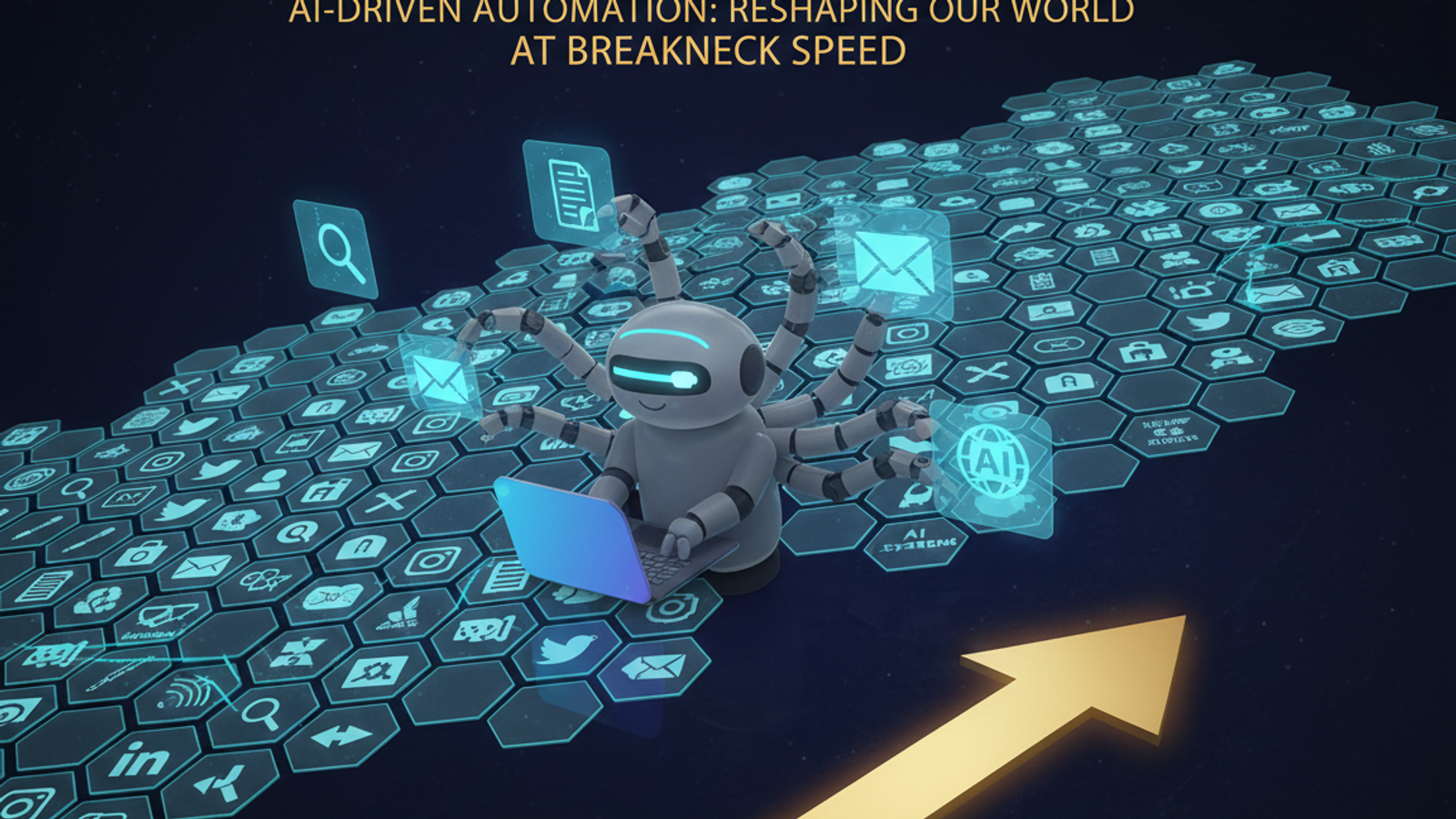
Artificial Intelligence has shed its sci-fi skin. No longer a distant promise, it’s the invisible engine in our daily lives: curating our playlists, streamlining global shipping, flagging fraudulent transactions, and aiding in early medical diagnoses. Yet, this pervasive presence is merely the overture. We are on the cusp of a transformation driven by AI-driven automation that will redefine work, business, and society at a pace that makes the Industrial Revolution look slow-motion.
From Rule-Based to Cognitive: A New Automation Paradigm
Traditional automation was built on rigid instructions: simple "if-then" commands guiding robotic arms and basic software. AI shatters this mold. Modern systems learn from vast datasets, adapt to novel scenarios, and make informed decisions amidst uncertainty. Machine learning models uncover patterns imperceptible to the human eye and continuously refine their performance.
This evolution shifts automation from mechanical task replacement to intelligent workflow management. We now see:
- Customer service platforms resolving complex inquiries autonomously.
- Supply chains that anticipate demand fluctuations weeks in advance.
- Cybersecurity systems identifying and neutralizing threats in real-time.
- Marketing engines delivering hyper-personalized content to millions simultaneously.
The leap is from mere execution to cognitive collaboration.
The Future of Work: Transformation, Not Extinction
The specter of mass unemployment haunts discussions of AI, but history suggests a different narrative. Technological waves reshape labor markets; they rarely erase them. The rise of computers reduced demand for typists but spawned entire new fields like software engineering and digital marketing. AI is accelerating this cycle.
Roles centered on repetitive, predictable tasks are most susceptible to automation:
- Data entry and routine analysis
- Basic accounting and transaction processing
- Standardized customer service
- Manual quality inspection
Concurrently, demand will surge for skills that are inherently human:
- Creative problem-solving and innovation
- Strategic oversight and system design
- Ethical governance and bias mitigation in AI
- Empathetic communication and negotiation
- High-level judgment and decision-making
The professional landscape will increasingly pivot from humans doing the task to humans overseeing, guiding, and improving the intelligent systems that perform it at scale.
The Hyper-Efficient Enterprise: Speed, Scale, and Democratization
For businesses, AI automation transcends cost reduction. It is a catalyst for unprecedented speed, precision, and agility. Imagine factories that self-optimize production in real time, retail pricing that dynamically adjusts to micro-trends, or logistics networks that instantly reroute around disruptions.
This power is being democratized. AI tools now enable a small startup to perform market analysis, global marketing, and 24/7 customer support—capabilities once exclusive to corporate giants. This levels the competitive field, allowing innovation to spring from anywhere on the globe.
Beyond Business: Reinventing Society’s Foundations
The impact extends far beyond commerce into the pillars of society:
- Healthcare: AI assists in analyzing medical imagery, predicting patient risks, and accelerating drug discovery from years to months.
- Scientific Research: Algorithms sift through colossal datasets—from genomic sequences to climate models—unlocking discoveries that could take human researchers lifetimes.
- Smart Cities: Intelligent systems manage traffic flow to reduce congestion, optimize energy grids for efficiency, and streamline waste collection to lower emissions.
Here, automation isn't about convenience; it's about saving lives, conserving resources, and building a sustainable future.
The Imperative of Ethics and Human Oversight
This power demands profound responsibility. AI systems can perpetuate societal biases embedded in their training data. Their "black box" nature raises critical questions about transparency, accountability, and privacy. Who is liable when an autonomous system causes harm?
Developing robust frameworks is the urgent task of our time, requiring collaboration between governments, technologists, and civil society. Priorities include:
- Ensuring fairness and mitigating bias in algorithms.
- Creating explainable AI for auditable decisions.
- Strengthening data privacy and security protections.
- Investing in large-scale workforce reskilling and transition.
- Maintaining meaningful human oversight for critical systems.
The central challenge is not just what AI can do, but what we should allow it to do.
The Augmentation Age: Partnership as Progress
The most profound potential of AI lies not in replacement, but in augmentation. It is the doctor amplified by a diagnostic assistant, the engineer exploring designs with generative AI, the teacher empowered by a personalized learning platform, and the researcher uncovering insights from terabytes of data in minutes.
Humans contribute the irreplaceable: ethical judgment, emotional empathy, creative vision, and contextual wisdom. The next decade will be defined by synergistic partnerships that leverage the scale and speed of machines with the ingenuity and values of humanity.
Conclusion: Navigating the Acceleration
AI-driven automation is not a future forecast; it is our present reality, and its trajectory points toward exponential growth. Its influence will touch every industry, institution, and aspect of our lives.
Adaptability is the new imperative. Those who embrace lifelong learning and collaborate with these technologies will be the architects of the future. Those who resist may find themselves struggling to keep pace.
We stand at the precipice of a revolution that will redefine productivity, creativity, and the very fabric of society. The question is no longer if AI will change the world. It is how wisely, and justly, we will steer the change it brings.